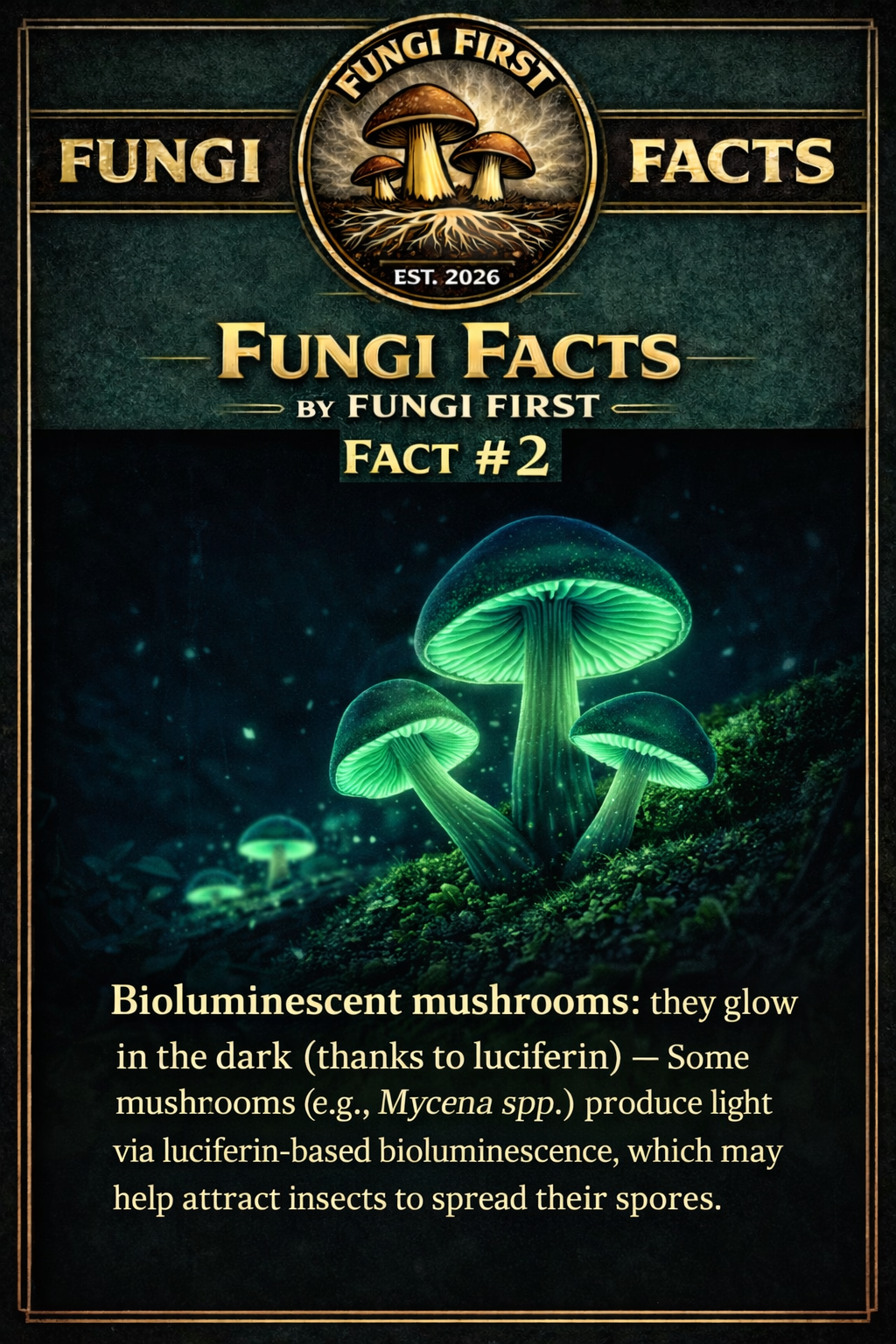
FACT #2 — Bioluminescent mushrooms glow in the dark
Some mushrooms really do glow on their own. Not because they “soaked up sunlight,” and not because something is reflecting off them—these fungi are producing light from inside their living tissues through true bioluminescence. https://pmc.ncbi.nlm.nih.gov/articles/PMC10053366/
The basic idea is simple: the fungus has a light-making chemical (called luciferin) and a helper protein (an enzyme called luciferase). When luciferase reacts with luciferin (with oxygen involved), the reaction releases energy as visible light—like a tiny built-in lantern. https://pmc.ncbi.nlm.nih.gov/articles/PMC5406138/
You’ll sometimes see scientists describe the glow using numbers like 520–530 nm. “nm” means nanometers, and that’s just the unit scientists use to measure light wavelength, which is basically what gives light its “color.” Human eyes usually see light from about 380 to 700 nanometers, and 520–530 sits in the green part of that range—so it’s literally describing “green-ish light” in a measured, testable way. https://science.nasa.gov/ems/09_visiblelight/
And there are more glowing fungi than most people realize. A 2024 scientific review reports the known number of bioluminescent fungal species has more than doubled in the last ~15 years—from 64 to 132 species. That same review breaks them into five main lineages, including Mycenaceae (96 species), Omphalotaceae (18), Physalacriaceae (14), plus two smaller groups (3 and 1 species). https://www.mdpi.com/2309-608X/11/1/19
So why would a mushroom glow at all? In at least one species (Neonothopanus gardneri), researchers tested the idea that the glow helps attract insects at night. They used controlled experiments (including fake “mushrooms” with green lights) and found evidence that light can increase insect visits—meaning glow can work like a nighttime sign that says “come check this out,” which could help spores get moved around in some forests. https://www.cell.com/current-biology/fulltext/S0960-9822%2815%2900160-8
But here’s the honest part that matters: that’s not true for every glowing fungus. A study on the Australian “ghost fungus” (Omphalotus nidiformis) found its glow did not attract potential spore-dispersing insects in their tests. So the safest, most real explanation is: glowing can help attract insects in some species and situations, but fungi don’t all use the glow for the same reason. https://pmc.ncbi.nlm.nih.gov/articles/PMC5159592/