

FACT #5 — Leafcutter ants are fungus farmers (seriously)
FACT #5 — Leafcutter ants are fungus farmers (seriously)
Leafcutter ants don’t cut leaves because they love salad. They cut leaves to feed a fungus they grow underground—because the fungus is the real food source for the colony. If you’ve ever seen a line of ants carrying leaf pieces like green flags, you’re basically watching an underground farm getting stocked up. https://asm.org/articles/2017/september/the-leaf-cutter-ant-s-50-million-years-of-farming
The fungus they raise is commonly called Leucoagaricus gongylophorus (you’ll also see it discussed under closely related names in the scientific literature). The fungus makes tiny nutrient-packed “food pods” called gongylidia, and the ants harvest those to feed the colony (especially the larvae). That’s the trade: ants bring plant material, the fungus turns it into usable nutrients.
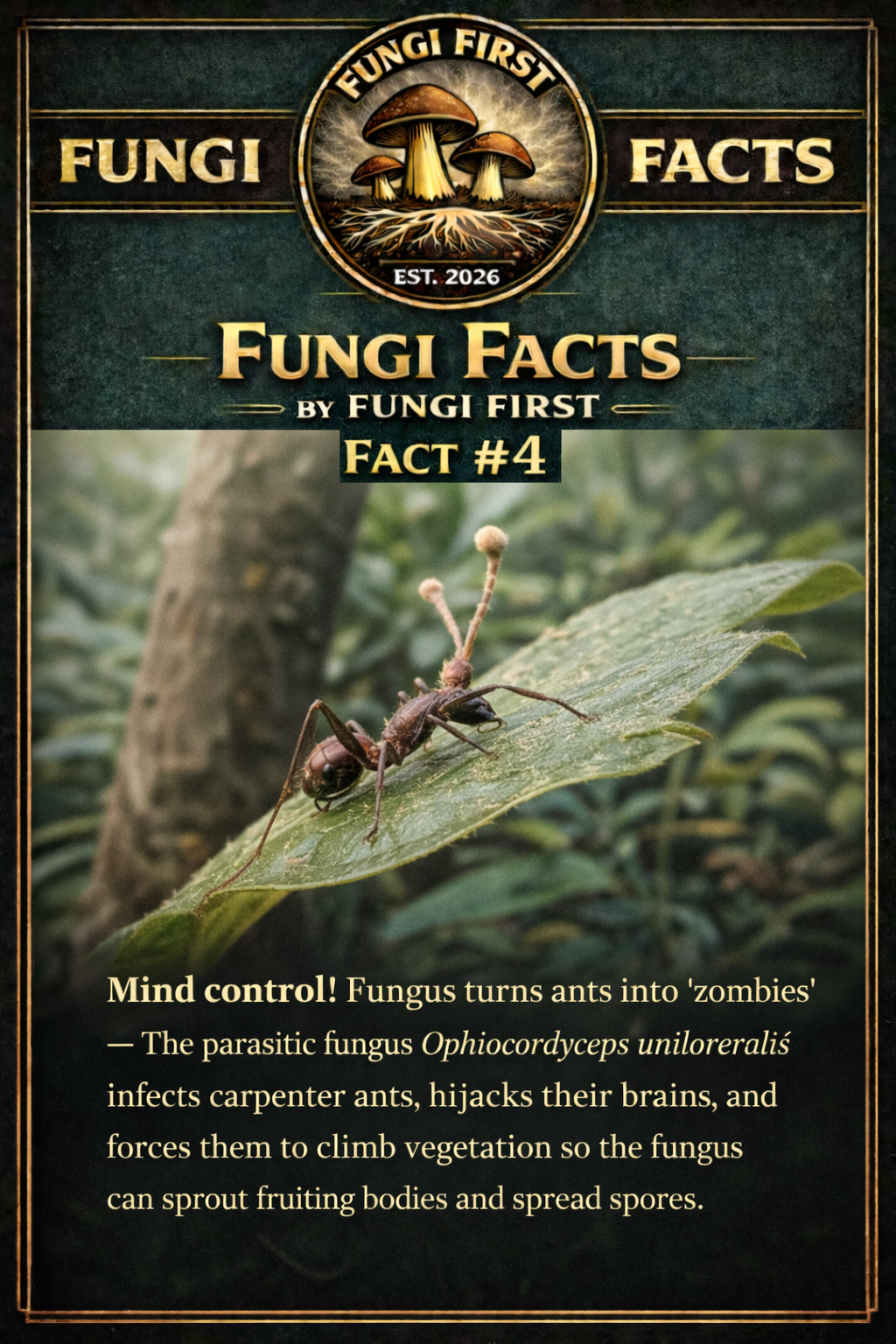
FACT #4 — The “zombie ant” fungus can control an ant’s behavior
FACT #4 — The “zombie ant” fungus can control an ant’s behavior
Some fungi don’t just kill insects — they steer them. In one of the most famous examples, a fungus in the Ophiocordyceps unilateralis group infects certain carpenter ants and can trigger a weird set of behaviors that ends with the ant leaving the colony, climbing up plants, and getting stuck in place. That “stuck” moment helps the fungus finish its life cycle. https://pmc.ncbi.nlm.nih.gov/articles/PMC3118224/
Here’s the part people usually get wrong: it’s not like the fungus is “driving the ant like a remote-control car” from inside the ant’s brain. In fact, researchers have found that in these infections the fungus can spread through much of the ant’s body without invading the brain, and evidence suggests a lot of the control may happen through chemicals and direct effects on muscles (more like a puppet pulling strings than a little pilot inside the head). https://www.psu.edu/news/research/story/zombie-ant-brains-left-intact-fungal-parasite

FACT #3 — Humans are surprisingly closely related to fungi
FACT #3 — Humans are surprisingly closely related to fungi
If you zoom out far enough on the family tree of life, fungi are not “basically plants.” They’re actually closer to animals (including us) than they are to plants. Scientists group animals and fungi together in a big branch called Opisthokonta, which is one reason fungi show up in biology and medicine way more than most people expect. https://asm.org/articles/2021/january/three-reasons-fungi-are-not-plants
So what does “we share DNA with fungi” really mean? It doesn’t mean half of your DNA is “mushroom DNA.” It means that when scientists compare genes between species, they often find matching or related genes (called orthologs) that came from the same ancient ancestor and still do similar jobs today. That’s how researchers measure how “related” two living things are at the genetic level. https://pmc.ncbi.nlm.nih.gov/articles/PMC9194483/

FACT #2 — Bioluminescent mushrooms glow in the dark
FACT #2 — Bioluminescent mushrooms glow in the dark
Some mushrooms really do glow on their own. Not because they “soaked up sunlight,” and not because something is reflecting off them—these fungi are producing light from inside their living tissues through true bioluminescence. https://pmc.ncbi.nlm.nih.gov/articles/PMC10053366/
The basic idea is simple: the fungus has a light-making chemical (called luciferin) and a helper protein (an enzyme called luciferase). When luciferase reacts with luciferin (with oxygen involved), the reaction releases energy as visible light—like a tiny built-in lantern. https://pmc.ncbi.nlm.nih.gov/articles/PMC5406138/

The biggest living thing on Earth is a Fungus
In Oregon’s Malheur National Forest, the biggest living organism on Earth is a fungus. (Oregon Encyclopedia)
It’s one single, genetically connected individual of the honey mushroom fungus (Armillaria ostoyae), known as the Humongous Fungus. What makes it hard to wrap your head around is that most of it is hidden. The organism is mainly an underground mycelium network running through soil and tree roots. The mushrooms people notice are just the fruiting bodies it produces, not the main body. (Oregon Encyclopedia; Oregon Public Broadcasting, Oregon Field Guide)
This one organism has been documented at about 2,385 acres (roughly 3.7 square miles). It has also been described as potentially up to about 8,650 years old. That is a living network, holding ground under a whole forest. (Oregon Encyclopedia)