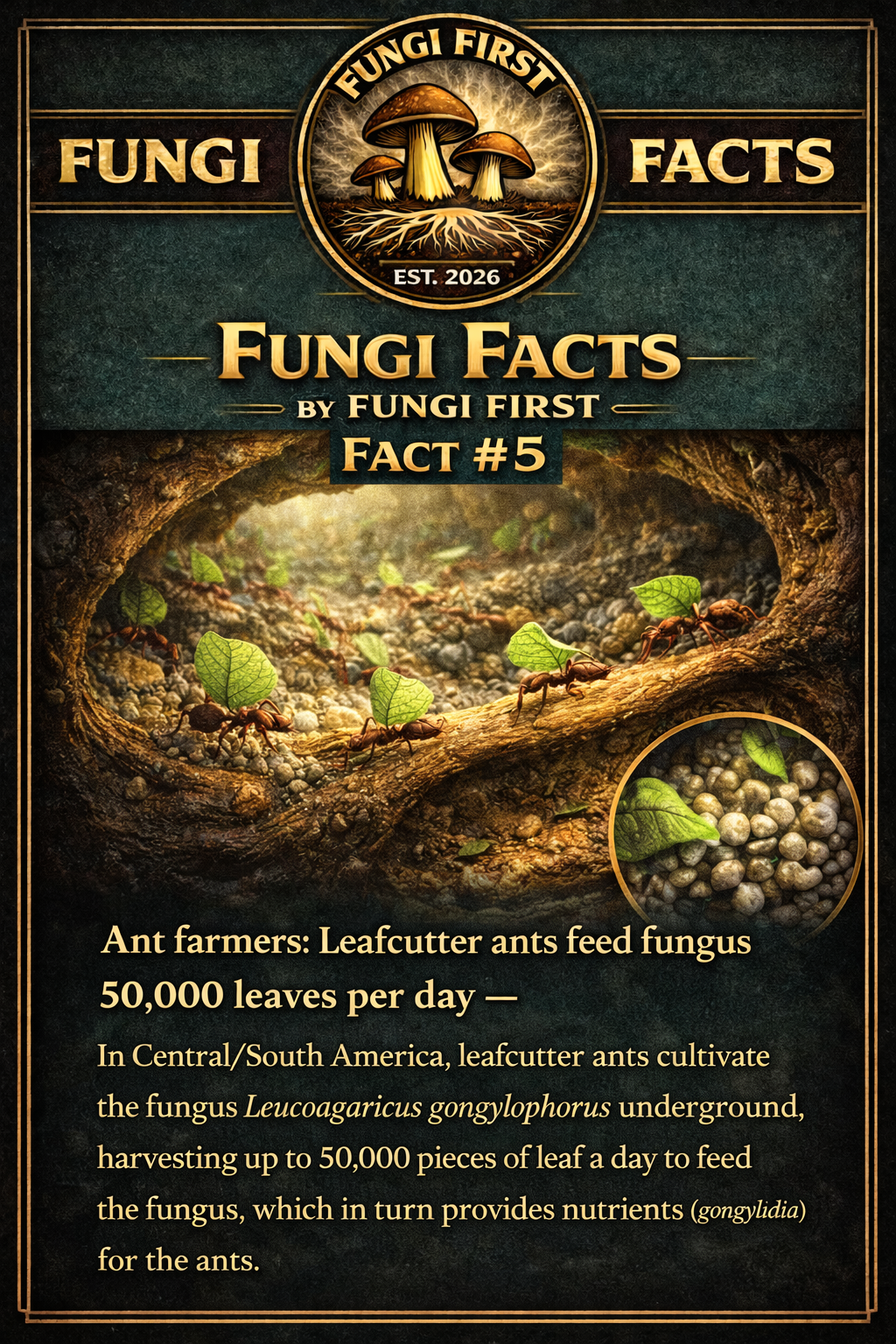
FACT #5 — Leafcutter ants are fungus farmers (seriously)
Leafcutter ants don’t cut leaves because they love salad. They cut leaves to feed a fungus they grow underground—because the fungus is the real food source for the colony. If you’ve ever seen a line of ants carrying leaf pieces like green flags, you’re basically watching an underground farm getting stocked up. https://asm.org/articles/2017/september/the-leaf-cutter-ant-s-50-million-years-of-farming
The fungus they raise is commonly called Leucoagaricus gongylophorus (you’ll also see it discussed under closely related names in the scientific literature). The fungus makes tiny nutrient-packed “food pods” called gongylidia, and the ants harvest those to feed the colony (especially the larvae). That’s the trade: ants bring plant material, the fungus turns it into usable nutrients. https://pmc.ncbi.nlm.nih.gov/articles/PMC10503033/
Inside the nest, the leaf pieces don’t just get piled up. Workers chew and process the leaves into a moist pulp, then place it into garden chambers and inoculate it with the fungus so it can grow through it. Researchers have documented this step-by-step “leaf processing” as part of how leafcutter ants run their fungus gardens like a living factory. https://pmc.ncbi.nlm.nih.gov/articles/PMC4736916/
In large colonies, leafcutters can bring in huge amounts of plant material. One reputable science feature (based on expert interview and widely reported observations of the system) describes the fungus being fed roughly 50,000 leaves per day by the ants in its rainforest setting. It’s easiest to picture as “tens of thousands of leaf pieces every day” moving underground to keep the farm running. https://www.sciencefocus.com/nature/leaf-cutter-ants-fungi
What makes this partnership so powerful is that the ants can’t properly digest tough plant material on their own the way their fungus can. So instead of eating the leaves directly, they outsource digestion to their crop and then eat the fungus-made nutrients. That’s a big reason scientists describe this as an ancient, highly successful mutualism—two species doing what neither could do as well alone. https://pmc.ncbi.nlm.nih.gov/articles/PMC4553616/
And because any farm can get “weeds” or disease, these ants also have serious defenses for their gardens. Research reviews describe multiple layers of protection in fungus-growing ant systems, including antimicrobial defenses that help keep their fungal crop from being overrun. https://repository.si.edu/server/api/core/bitstreams/bc8b4fa8-42ff-43c9-85f3-4a8a9ac7219c/content